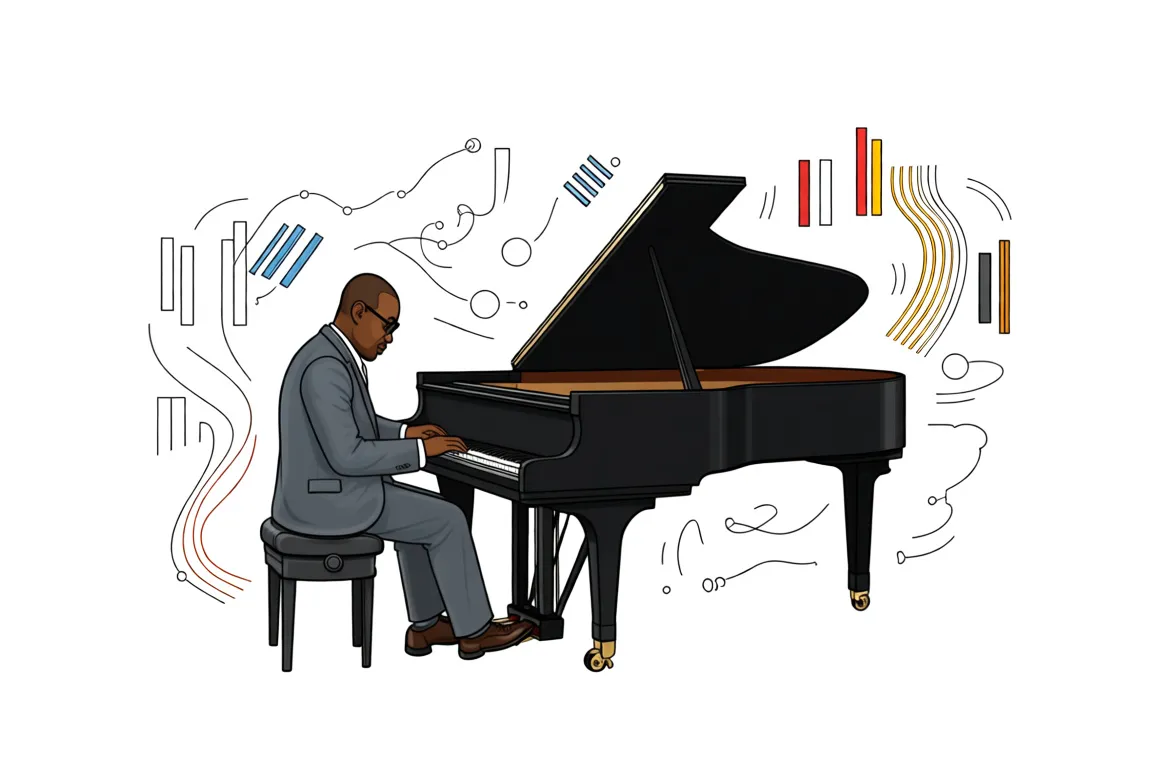
The Piano’s Role in Jazz Improvisation: From Monk to Mehldau
The piano lets you shape melody, harmony, and rhythm at once. That single fact explains why players from Thelonious Monk to Brad Mehldau keep finding new ways to improvise on it.
Core Piano Skills for Jazz Improv
You need three things in your hands before the ideas flow: steady time, clear chord changes, and a way to move between them without clutter. Start simple. Play rootless voicings in the right hand while the left keeps quarter-note pulse. Once that sits, add one extra note per chord to outline the changes.
Monk’s Rhythmic Displacement
Monk treated the piano like a drum set. On “Straight, No Chaser” he lands accents just behind the beat, then snaps back on the next phrase. The left hand often stays on one or two notes while the right hand plays angular lines. Copy that feel on a blues head: play the melody once straight, then shift every other note an eighth note late. Keep the left hand minimal so the delay stands out.
Mehldau’s Layered Harmonies
Mehldau stacks inner voices that move independently of the melody. Listen to his version of “Martha My Dear.” The right hand plays the tune while the left adds moving thirds and sixths that create new tensions. Try this on a standard ballad: take one chorus where you keep the melody in the top voice and let two lower voices shift by half steps against it.
Practice Steps for Your Solos
- Pick a 12-bar blues and record yourself comping for one chorus with only rootless shells.
- Take the same form and improvise using only chord tones, no passing notes.
- Add one chromatic approach note per bar on the next pass.
- Listen back and mark the bars where the rhythm felt alive. Repeat those bars until the phrasing sticks.
Recordings That Show the Evolution
| Player | Track | What to notice |
|---|---|---|
| Monk | Blue Monk (1957) | Left-hand stabs and right-hand pauses |
| Mehldau | Countdown (from Art of the Trio Vol. 4) | Independent inner lines during the head |